

Unit Price:
৳ 45.00
(1 x 10: ৳ 450.00)
Strip Price:
৳ 450.00
Also available as:
Indications
TRB tablet is indicated in conjunction with diet and exercise for the treatment of adults with noncirrhotic nonalcoholic steatohepatitis (NASH) with moderate to advanced liver fibrosis (consistent with stages F2 to F3 fibrosis).
Pharmacology
Resmetirom is a partial agonist of the thyroid hormone receptor-beta (THR-β). Resmetirom produced 83.8% of the maximum response compared to triiodothyronine (T3), with an EC50 of 0.21 μM in an in vitro functional assay for THR-β activation. The same functional assay for thyroid hormone receptor alpha (THR-α) agonism showed 48.6% efficacy for Resmetirom relative to T3, with an EC50 of 3.74 pM. THR-p is the major form of THR in the liver, and stimulation of THR-β in the liver reduces intrahepatic triglycerides.
Dosage & Administration
The recommended dose of Resmetirom is based on actual body weight. For patients weighing:
- <100 kg, the recommended dose is 80 mg orally once daily.
- >100 kg, the recommended dose is 100 mg orally once daily.
Interaction
Effects of Other Drugs on TRB: Strong or Moderate CYP2C8 Inhibitors: Concomitant use of TRB with a strong or moderate CYP2C8 inhibitor can increase the risk of TRB adverse reactions. Concomitant use of TRB with strong CYP2C8 inhibitors (e.g., Gemfibrozil) is not recommended. If used concomitantly with a moderate CYP2C8 inhibitor (e.g., Clopidogrel) TRB dose should be reduced, as:
Effects of TRB on Other Drugs: Statins (Atorvastatin, Pravastatin, Rosuvastatin, or Simvastatin): TRB increases plasma concentrations of some statins (Atorvastatin, Pravastatin, Rosuvastatin and Simvastatin), which may increase the risk of adverse reactions related to these drugs. Dose adjustment of statins is recommended.
- For patients weighting <100 kg TRB dose should be 60 mg once daily.
- For patients weighting >100 kg TRB dose should be 80 mg once daily.
Effects of TRB on Other Drugs: Statins (Atorvastatin, Pravastatin, Rosuvastatin, or Simvastatin): TRB increases plasma concentrations of some statins (Atorvastatin, Pravastatin, Rosuvastatin and Simvastatin), which may increase the risk of adverse reactions related to these drugs. Dose adjustment of statins is recommended.
- Rosuvastatin and Simvastatin: Maximum daily statin dose should be 20 mg.
- Pravastatin and Atorvastatin: Maximum daily statin dose should be 40 mg.
Side Effects
The common side effects of TRB are: Diarrhea, Nausea, Vomiting, Abdominal pain, Dizziness, Pruritus, Constipation.
Pregnancy & Lactation
Pregnancy: There are no available data on Resmetirom use in pregnant women to evaluate for a drug associated risk of major birth defects, miscarriage, or other adverse maternal or fetal outcomes.
Lactation: There is no information regarding the presence of Resmetirom in human or animal milk, the effects on the breast-fed infant, or the effects on milk production. The developmental and health benefits of breastfeeding should be considered along with the mother's clinical need for Resmetirom and any potential adverse effects on the breastfed infant from Resmetirom or from the underlying maternal condition.
Lactation: There is no information regarding the presence of Resmetirom in human or animal milk, the effects on the breast-fed infant, or the effects on milk production. The developmental and health benefits of breastfeeding should be considered along with the mother's clinical need for Resmetirom and any potential adverse effects on the breastfed infant from Resmetirom or from the underlying maternal condition.
Precautions & Warnings
Hepatotoxicity: Hepatotoxicity has been observed with use of TRB. Monitoring of patient is required during treatment with TRB for elevations in liver tests, for the development of liver-related adverse reactions and for sign & symptoms of hepatotoxicity. If hepatotoxicity is suspected, TRB should be discontinued and monitoring of the patient should be continued. If laboratory values return to baseline, the potential risks against the benefits of restarting TRB should be considered. If laboratory values do not return to baseline, DI-ALH or autoimmune liver disease should be considered in the evaluation of elevations in liver tests.
Gallbladder-Related Adverse Reactions: In clinical trials, cholelithiasis, acute cholecystitis, and obstructive pancreatitis (gallstone) were observed in TRB-treated patients. If cholelithiasis is suspected, gallbladder diagnostic studies and appropriate clinical follow-up are indicated , If an acute gallbladder event is suspected, TRB treatment
should be interrupted until the event is resolved.
Drug Interaction with Certain Statins: An increase in exposure of Atorvastatin, Pravastatin, Rosuvastatin and Simvastatin was observed when concomitantly administered with TRB, which may increase the risk of adverse reactions related to these drugs. Dosage adjustment for certain statins is recommended.
Gallbladder-Related Adverse Reactions: In clinical trials, cholelithiasis, acute cholecystitis, and obstructive pancreatitis (gallstone) were observed in TRB-treated patients. If cholelithiasis is suspected, gallbladder diagnostic studies and appropriate clinical follow-up are indicated , If an acute gallbladder event is suspected, TRB treatment
should be interrupted until the event is resolved.
Drug Interaction with Certain Statins: An increase in exposure of Atorvastatin, Pravastatin, Rosuvastatin and Simvastatin was observed when concomitantly administered with TRB, which may increase the risk of adverse reactions related to these drugs. Dosage adjustment for certain statins is recommended.
Use in Special Populations
Pediatric Use: The safety and effectiveness of TRB have not been established in pediatric patients.
Geriatric Use: No overall differences in effectiveness but numerically higher incidence of advers reactions have been observed in patients 65 years of age and older who received TRB compared to younger adult patients.
Renal Impairment: The recommended dose of TRB in patients with mild or moderate renal impairment is the same as in patients with normal kidney function. TRB has not been studied in patients with severe renal impairment.
Hepatic Impairment: Use of TRB in patients with decompensated cirrhosis (consistent with moderate to severe hepatic impairment) should be avoided. Moderate or severe hepatic impairment (Chiid-Pugh Class B or C) may increase the risk of adverse reactions of TRB. No dose adjustment is recommended for patients with mild hepatic impairment (Child-Pugh Class A).
Geriatric Use: No overall differences in effectiveness but numerically higher incidence of advers reactions have been observed in patients 65 years of age and older who received TRB compared to younger adult patients.
Renal Impairment: The recommended dose of TRB in patients with mild or moderate renal impairment is the same as in patients with normal kidney function. TRB has not been studied in patients with severe renal impairment.
Hepatic Impairment: Use of TRB in patients with decompensated cirrhosis (consistent with moderate to severe hepatic impairment) should be avoided. Moderate or severe hepatic impairment (Chiid-Pugh Class B or C) may increase the risk of adverse reactions of TRB. No dose adjustment is recommended for patients with mild hepatic impairment (Child-Pugh Class A).
Storage Conditions
Store below 30°C, in a cool and dry place. Keep away from light. Keep out of the reach of children.
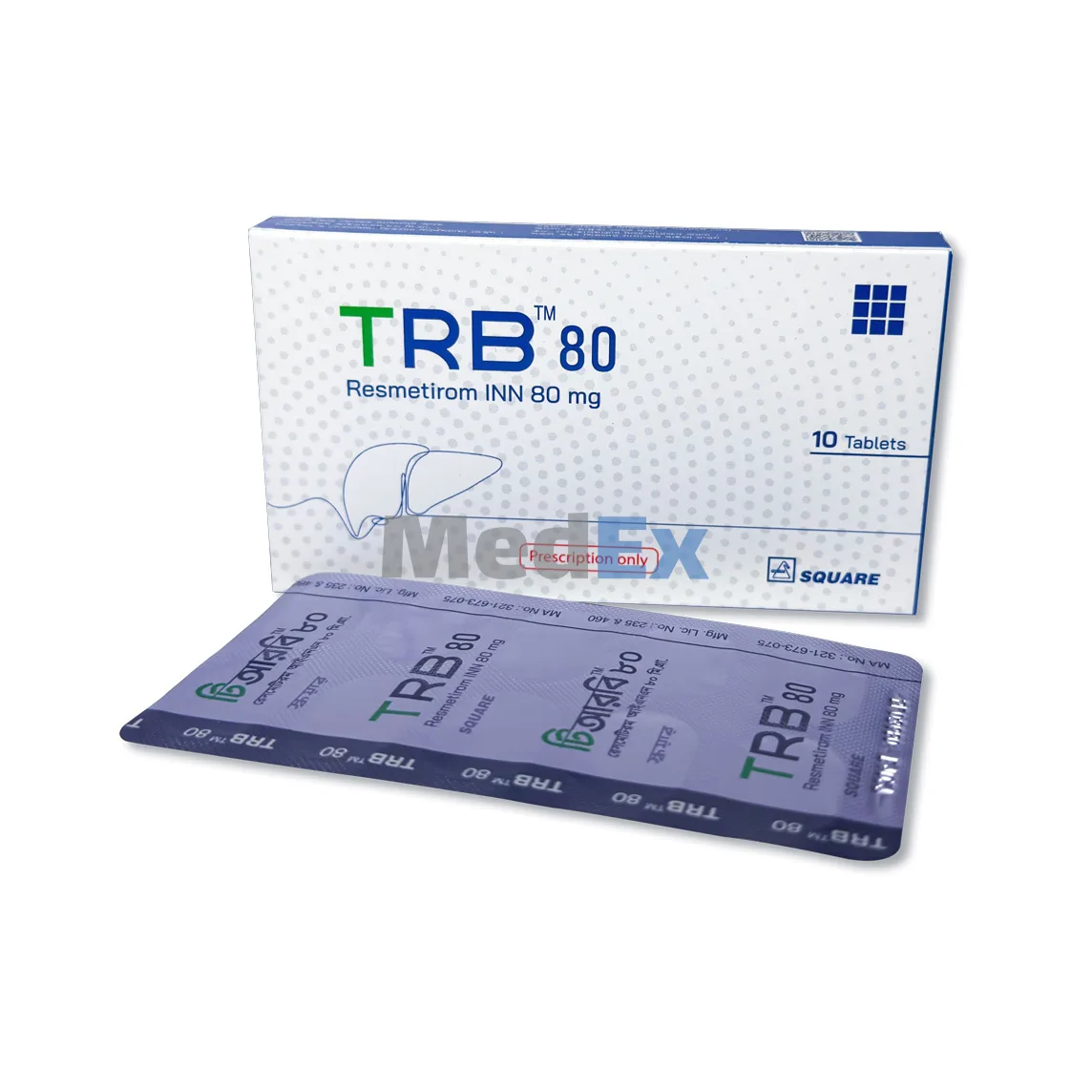 Pack Image: TRB 80 mg Tablet