

Unit Price:
৳ 10.00
(5 x 10: ৳ 500.00)
Strip Price:
৳ 100.00
Indications
Adults (from the age of 18 years)-
Gastroesophageal reflux disease (GERD):
Reduction of risk of NSAID associated gastric ulcers
Zollinger-Ellison Syndrome
H. pylori eradication
Pediatrics (12-17 years of age)-
Gastroesophageal reflux disease (GERD):
- Non-erosive reflux disease (NERD) (i.e. heartburn and regurgitation),
- Maintenance treatment of NERD (i.e. heartburn and regurgitation),
- Reflux esophagitis or erosive esophagitis,
- Maintenance treatment of patients with reflux esophagitis
Reduction of risk of NSAID associated gastric ulcers
Zollinger-Ellison Syndrome
H. pylori eradication
Pediatrics (12-17 years of age)-
- Gastroesophageal reflux disease (GERD)
- Non-erosive reflux disease (NERD) (i.e. heartburn and regurgitation)
- Reflux esophagitis or erosive esophagitis.
Composition
20 mg tablet: It contains Esomeprazole Magnesium Trihydrate USP enteric coated micro pellets equivalent to Esomeprazole 20 mg.
40 mg tablet: It contains Esomeprazole Magnesium Trihydrate USP enteric coated micro pellets equivalent to Esomeprazole 40 mg.
20 mg capsule: It contains Esomeprazole Magnesium Trihydrate USP enteric coated micro pellets equivalent to Esomeprazole 20 mg.
40 mg capsule: It contains Esomeprazole Magnesium Trihydrate USP enteric coated micro pellets equivalent to Esomeprazole 40 mg.
40 mg tablet: It contains Esomeprazole Magnesium Trihydrate USP enteric coated micro pellets equivalent to Esomeprazole 40 mg.
20 mg capsule: It contains Esomeprazole Magnesium Trihydrate USP enteric coated micro pellets equivalent to Esomeprazole 20 mg.
40 mg capsule: It contains Esomeprazole Magnesium Trihydrate USP enteric coated micro pellets equivalent to Esomeprazole 40 mg.
Description
MUPS is abbreviation for Multiple-Unit Pellet System. However, from pharmaceutical industry and research perspective, the term in general refers to MUPS compacted into tablets. Thus, the resulting tablets prepared by compaction of modified release coated multiparticulates or pellets are called as MUPS. It is the more recent and challenging technologies that combine the advantages of both tablets and pellet-filled capsules in one dosage form.
A further reduction in inter- and intra-subject variability in drug absorption and clinical response is facilitated since the number of pellets per MUPS dosage form is much more than a conventional pellet-filled capsule and possibility of dose dumping (in stomach) and incomplete drug release is further minimized.
- Ensures greater bioavailability.
- Ensures uniform emptying of micro pellets from stomach into small intestine facilitates rapid dissolution of enteric coating and drug release resulting in early Tmax and Cmax
- Ensures lesser possibility of dose dumping.
- Is a combination of fast acting and sustained action.
- Ensures uniform drug release.
- Once daily dosing.
- Ensures lesser chance of localized irritation.
- Ensures better and more uniform drug absorption.
- Is better than capsules in reducing the esophageal residence time.
- Minimizes fluctuation in plasma concentration of drug.
A further reduction in inter- and intra-subject variability in drug absorption and clinical response is facilitated since the number of pellets per MUPS dosage form is much more than a conventional pellet-filled capsule and possibility of dose dumping (in stomach) and incomplete drug release is further minimized.
Pharmacology
The proton pump inhibitor Esomeprazole inhibits gastric acid by blocking the hydrogen-potassium adenosine triphosphatase enzyme system (the proton pump) of the gastric parietal cell. Proton pump inhibitors are effective for short-term treatment of gastric and duodenal ulcers. Esomeprazole is also used in the prevention and treatment of NSAID associated gastric ulcers.
Dosage
Adults (from the age of 18 years)-
Gastroesophageal reflux disease (GERD):
Risk reduction of NSAID associated gastric ulcers: 20 mg Once daily
Zollinger-Ellison Syndrome: 40 mg Twice daily
H. pylori eradication (Esomeprazole with amoxicillin 1000 mg and clarithromycin 500 mg): 20 mg tab. twice daily for 7 days or 40 mg cap. once daily for 10 days
Pediatrics (12 to 17 years)-
Gastroesophageal reflux disease (GERD):
Gastroesophageal reflux disease (GERD):
- Non-erosive reflux disease (NERD) (i.e. heartburn and regurgitation): 20 mg Once daily for 24 weeks
- Maintenance treatment of NERD (i.e. heartburn and regurgitation): 20 mg Once daily
- Reflux esophagitis or erosive esophagitis: 20 mg or 40 mg Once daily for 4-8 weeks
- Maintenance therapy of healing of reflux esophagitis: 20 mg Once daily
Risk reduction of NSAID associated gastric ulcers: 20 mg Once daily
Zollinger-Ellison Syndrome: 40 mg Twice daily
H. pylori eradication (Esomeprazole with amoxicillin 1000 mg and clarithromycin 500 mg): 20 mg tab. twice daily for 7 days or 40 mg cap. once daily for 10 days
Pediatrics (12 to 17 years)-
Gastroesophageal reflux disease (GERD):
- Non-erosive reflux disease (NERD) (i.e. heartburn and regurgitation): 20 mg Once daily for 2-4 weeks
- Reflux esophagitis or erosive esophagitis: 20 mg or 40 mg Once daily for 4-8 weeks.
Administration
Esomeprazole MUPS tablet is taken orally with or without food. This should be swallowed whole with liquid. The tablets should not be chewed or crushed. If required, the tablets can also be dispersed in half a glass of non-carbonated water (mineral water is not suitable). No other liquids should be used. Stir until the tablets disintegrate and drink the liquid with the pellets immediately or within 30 minutes. Rinse the glass with half a glass of water and drink. The pellets must not be chewed or crushed.
Interaction
E-MUPS is extensively metabolized in the liver by CYP2C19 and CYP3A4. In vitro and in vivo studies have shown that E-MUPS is not likely to inhibit CYPs 1A2, 2A6, 2C9, 2D6, 2E1 and 3A4. No clinically relevant interactions with drugs metabolized by these CYP enzymes would be expected. Drug interaction studies have shown that E-MUPS does not have any clinically significant interactions with phenytoin, warfarin, quinidine, clarithromycin or amoxicillin.
E-MUPS may potentially interfere with CYP2C19, the major E-MUPS metabolizing enzyme. Co-administration of E-MUPS 30 mg anddiazepam, a CYP2C19 substrate has resulted in a 45% decrease in clearance of diazepam. Increased plasma levels of diazepam have been observed 12 hours after dosing and onwards. E-MUPS inhibits gastric acid secretion. Therefore, E-MUPS may interfere with the absorption of drugs where gastric pH is an important determinant of bioavailability (e.g., ketoconazole, iron salts and digoxin).
Co-administration of oral contraceptives, diazepam, phenytoin, or quinidine do not seem to change the pharmacokinetic profile of E-MUPS.
Combination Therapy with Clarithromycin: Co-administration of E-MUPS, clarithromycin, and amoxicillin has resulted in increases in the plasma levels of E-MUPS and 14-hydroxyclarithromycin.
E-MUPS may potentially interfere with CYP2C19, the major E-MUPS metabolizing enzyme. Co-administration of E-MUPS 30 mg anddiazepam, a CYP2C19 substrate has resulted in a 45% decrease in clearance of diazepam. Increased plasma levels of diazepam have been observed 12 hours after dosing and onwards. E-MUPS inhibits gastric acid secretion. Therefore, E-MUPS may interfere with the absorption of drugs where gastric pH is an important determinant of bioavailability (e.g., ketoconazole, iron salts and digoxin).
Co-administration of oral contraceptives, diazepam, phenytoin, or quinidine do not seem to change the pharmacokinetic profile of E-MUPS.
Combination Therapy with Clarithromycin: Co-administration of E-MUPS, clarithromycin, and amoxicillin has resulted in increases in the plasma levels of E-MUPS and 14-hydroxyclarithromycin.
Contraindications
Esomeprazole is contraindicated in patient with known hypersensitivity to any of the formulation.
Side Effects
The most common side effects of E-MUPS are nausea, vomiting, abdominal pain, flatulence, diarrhea, constipation and headache. Less frequent side effects include dry mouth, peripheral edema, dizziness, sleep disturbances, fatigue, paraesthesia, arthralgia, myalgia, rash and pruritus. Other side effects reported rarely or very rarely include taste disturbance, stomatitis, hepatitis, jaundice, hypersensitivity reactions (including anaphylaxis, bronchospasm), fever, depression, hallucinations, confusion, gynaecomastia, interstitial nephritis, hyponatraemia, blood disorders (including leucopenia, leukocytosis, pancytopenia, thrombocytopenia), visual disturbances, sweating, photosensitivity, alopecia, Stevens-Johnson Syndrome and toxic epidermal necrolysis.
Pregnancy & Lactation
Pregnancy: For esomeprazole, limited clinical data on exposed pregnancies are available. Esomeprazole should only be given to pregnant women if its use is considered essential.
Lactation: It is not known whether esomeprazole is excreted in breast milk. Therefore esomeprazole should not be used during breast-feeding.
Lactation: It is not known whether esomeprazole is excreted in breast milk. Therefore esomeprazole should not be used during breast-feeding.
Precautions & Warnings
E-MUPS should be used carefully if the patient has severe liver dysfunction and severe renal impairment. Taking a proton pump inhibitor like E-MUPS may slightly increase the risk of hip, wrist and spine fracture, particularly when it is taken over a period of more than one year.
Overdose Effects
There is very limited experience to date with deliberate overdose. The symptoms described in connection with 280 mg were gastrointestinal symptoms and weakness. Single doses of 80 mg E-MUPS were uneventful. No specific antidote is known. E-MUPS is extensively plasma protein bound and is therefore not readily dialyzable. As in any case of overdose, treatment should be symptomatic and general supportive measures should be utilized.
Therapeutic Class
Proton Pump Inhibitor
Storage Conditions
Store in a cool & dry place below 25ºC, protect from light. Keep out of reach of children.
Chemical Structure
| Molecular Formula : | C17H19N3O3S |
| Chemical Structure : | 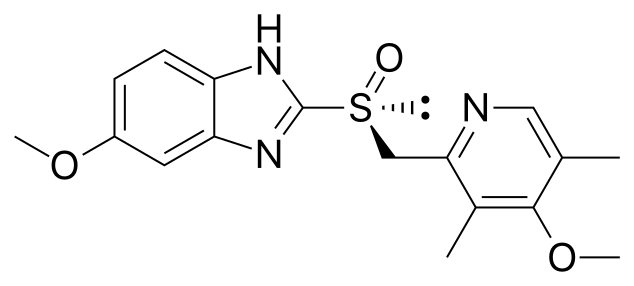 |
Common Questions about E-MUPS 20 mg MUPS Table
What is E-MUPS 20 mg MUPS Table?
E-MUPS 20 mg MUPS Table is a proton pump inhibitor (PPI). PPIs work by reducing the amount of acid produced in the stomach. E-MUPS 20 mg MUPS Table is used to treat gastroesophageal reflux disease (GERD), ulcers, and other conditions that involve too much stomach acid.
What is MUPS Tablet?
MUPS is abbreviation for Multiple-Unit Pellet System. This tablets prepared by compaction of modified release coated multiparticulates or pellets are called as MUPS.
What is E-MUPS 20 mg MUPS Table used for?
E-MUPS 20 mg MUPS Table has multiple uses. It relieves heartburn and GERD symptoms. It also aids in healing erosive esophagitis, a condition caused by stomach acid damaging the esophagus lining. Additionally, E-MUPS 20 mg MUPS Table effectively prevents erosive esophagitis recurrence.
What are the side effects of E-MUPS 20 mg MUPS Table?
E-MUPS 20 mg MUPS Table may cause common side effects like headaches, diarrhea, nausea, gas, stomach pain, constipation, and dry mouth. There aren't any differences in the types of side effects between long-term (up to 12 months) and short-term use.
Can I take E-MUPS 20 mg MUPS Table if I am pregnant or breastfeeding?
E-MUPS 20 mg MUPS Table doesn't have any side-effects if you are pregnant or breastfeeding. You still should talk to your doctor about the risks and benefits of taking E-MUPS 20 mg MUPS Table.
How long does it take for E-MUPS 20 mg MUPS Table to work?
E-MUPS 20 mg MUPS Table usually starts to work within a few hours of taking it.
Quick Tips
- E-MUPS 20 mg MUPS Table is a well-tolerated medicine and provides relief for a long time.
- Avoid eating late at night or before bedtime.
- Inform your doctor if you get watery diarrhea, fever or stomach pain that does not go away.
- Long-term use of E-MUPS 20 mg MUPS Table can cause weak bones and a deficiency of minerals such as magnesium. Take adequate dietary intake of calcium and magnesium or their supplements as prescribed by your doctor.
- Consult your doctor right away if you develop decreased urination, edema (swelling due to fluid retention), lower back pain, nausea, fatigue, and rash or fever. These could be signs of a kidney problem.