
World Glaucoma Week
March 8 - 14
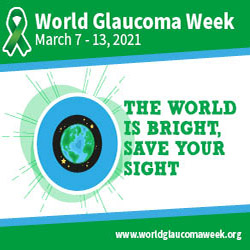
World Glaucoma Week is observed in the second full week of March and takes place from March 8 to 14 this year. It aims to create awareness about a medical condition that affects countless people around the world. The observance aims to prioritize early detection and treatment as glaucoma remains one of the major causes of blindness all over the globe.
History of World Glaucoma Week
World Glaucoma Week was launched in 2010 by the World Glaucoma Patient Association and the World Glaucoma Association to provide a forum for anyone seeking to enhance eye health to better comprehend the serious implications of glaucoma.
Glaucoma is a word that refers to a set of eye illnesses that are characterized by gradual and permanent optic nerve damage (the nerve in the eye that controls vision), and can lead to blindness if left untreated. Increased ocular pressure is one of the most important reasons, however, those with perfectly natural eye pressure can still suffer glaucoma. The two most prevalent kinds of glaucoma, according to the WHO, are Primary Open Angle Glaucoma (POAG), which has a gradual- and often sneaky- start, and Angle Closure Glaucoma (A.C.G.), which isn’t as common, but is more severe.
While the average person has a 2.3% chance of developing glaucoma, first-degree relatives (F.D.R.s) of affected patients face an increased risk of up to 10 times that amount. As a result, educating F.D.R.s about the importance of glaucoma detection, which includes an evaluation of the optic nerve, may help to prevent a lot of new cases.
Glaucoma is believed to be the cause of blindness in 4.5 million individuals, according to the WHO. Glaucoma is the major cause of permanent blindness in India, affecting approximately 12 million people and leaving 1.2 million blind. At the community level, more than 90% of glaucoma cases go undiagnosed.
Although little is known about glaucoma prevention, early detection and treatment is the ideal method to avoid glaucoma-related blindness.
History of World Glaucoma Week
World Glaucoma Week was launched in 2010 by the World Glaucoma Patient Association and the World Glaucoma Association to provide a forum for anyone seeking to enhance eye health to better comprehend the serious implications of glaucoma.
Glaucoma is a word that refers to a set of eye illnesses that are characterized by gradual and permanent optic nerve damage (the nerve in the eye that controls vision), and can lead to blindness if left untreated. Increased ocular pressure is one of the most important reasons, however, those with perfectly natural eye pressure can still suffer glaucoma. The two most prevalent kinds of glaucoma, according to the WHO, are Primary Open Angle Glaucoma (POAG), which has a gradual- and often sneaky- start, and Angle Closure Glaucoma (A.C.G.), which isn’t as common, but is more severe.
While the average person has a 2.3% chance of developing glaucoma, first-degree relatives (F.D.R.s) of affected patients face an increased risk of up to 10 times that amount. As a result, educating F.D.R.s about the importance of glaucoma detection, which includes an evaluation of the optic nerve, may help to prevent a lot of new cases.
Glaucoma is believed to be the cause of blindness in 4.5 million individuals, according to the WHO. Glaucoma is the major cause of permanent blindness in India, affecting approximately 12 million people and leaving 1.2 million blind. At the community level, more than 90% of glaucoma cases go undiagnosed.
Although little is known about glaucoma prevention, early detection and treatment is the ideal method to avoid glaucoma-related blindness.